
Type
Research News
Date
Feb 27, 2026
Reading Time
3 min
iEarth Contributes to New Open Earth Embedding Dataset for Global Land Monitoring
iEarth and its research partners have released ESD, an open ultra-lightweight Earth embedding dataset for long-term global land monitoring. Covering 2000–2024 at 30 m resolution, it helps lower the barrier to planetary-scale analysis. For more information, please contact contact@iearth.hk.
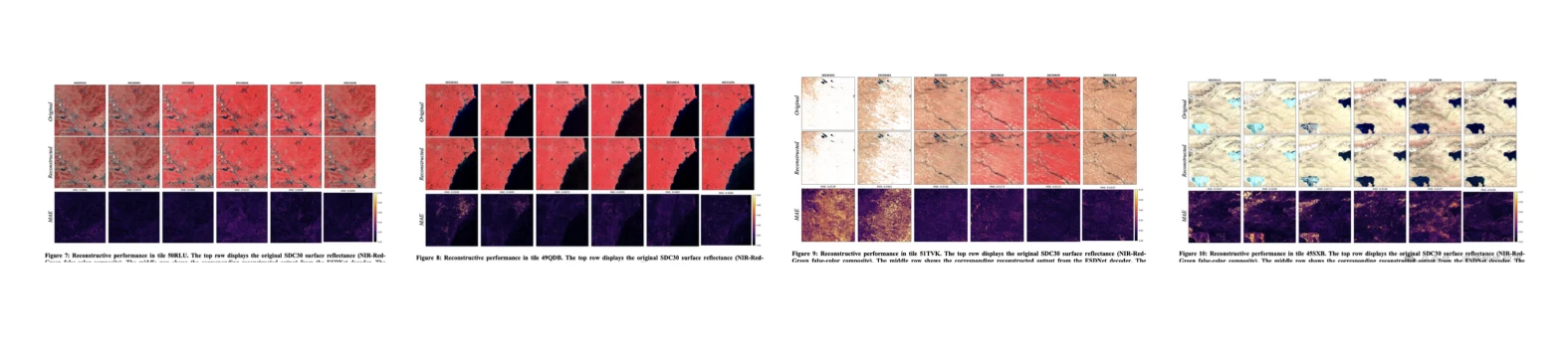
iEarth is pleased to share a new research milestone from our team and collaborators: Democratizing planetary-scale analysis: An ultra-lightweight Earth embedding database for accurate and flexible global land monitoring, now available on arXiv. The study introduces Embedded Seamless Data (ESD), an open Earth embedding database designed to make long-term, global-scale land monitoring significantly more accessible to researchers and developers.
The paper was released on 16 January 2026. It is led by Shuang Chen, Head of R&D at iEarth and a PhD graduate of The University of Hong Kong, and co-authored with collaborators from HKU, Peng Cheng Laboratory, The Hong Kong Polytechnic University, Tsinghua University, Sun Yat-sen University, and other partner institutions.
As remote sensing enters an era of continuous, long-term, global observation, the scale of data has become a major bottleneck for many teams. Planetary-scale analysis often requires storage and computing resources far beyond what ordinary research groups or small technical teams can easily access. ESD addresses this challenge by compressing multi-source satellite observations into a highly efficient representation while preserving their value for downstream analysis. According to the paper, the database covers global land at 30 m resolution from 2000 to 2024 and achieves an approximately 340× compression ratio, reducing one year of global land-surface data from roughly 0.8 PB to 2.4 TB.
For iEarth, the importance of this work lies in its practical value. By substantially lowering the storage and computational threshold for long-term global land monitoring, ESD helps make Earth intelligence more usable, scalable, and widely deployable. The research also shows that the compressed representation remains scientifically meaningful: it supports accurate reconstruction and performs strongly in downstream tasks such as land-cover classification and few-shot learning scenarios.
The project has been released openly to support broader research and application development. The code is available on GitHub, and the dataset is available through the iEarth data portal. This reflects iEarth’s continued commitment to building open, scalable geospatial AI infrastructure for both scientific research and real-world use cases.
Access
Paper: Democratizing planetary-scale analysis: An ultra-lightweight Earth embedding database for accurate and flexible global land monitoring (arXiv: 2601.11183).
Code: ESD GitHub repository.
For dataset access, download support, or more detailed information, please contact contact@iearth.hk.

Learn More